

Risk Management · 2025
In this section3 topics
Risk Management Policy & Plan
Policy & Plan Description
Proud Real Estate Public Company Limited (“the Company”) and its subsidiaries recognize the importance of Enterprise Risk Management (ERM) in supporting business operations to achieve strategic objectives and mitigating the impact of potential risk factors arising from both internal and external business operations.
The real estate development business involves various risk factors, such as the overall economic conditions of the country, the level of industry competition, demographic changes, climate change, as well as changes in laws and regulations related to the real estate business. Therefore, the company emphasizes establishing an efficient risk management system that aligns with international best practices.
The company adopts the COSO Enterprise Risk Management Framework as a guideline for establishing its organizational risk management policies, processes, and governance mechanisms, covering various risk areas, including:
Strategic Risk
Operational Risk
Financial Risk
Legal and Regulatory Compliance Risk (Compliance Risk)
The company mandates regular review and assessment of organizational risks to ensure that risk management measures can be adapted to changing business environments, and to ensure that the company's operations comply with relevant laws and regulations, as well as good corporate governance principles.
Structure of the Risk Management Committee
The company establishes its risk governance structure through the Risk Management Committee, which comprises company directors, independent directors, executive directors, and senior management. The Chairman of the Risk Management Committee, possessing knowledge and experience in the company's business, is responsible for overseeing that the organization's risk management operations adhere to the defined framework and align with its vision.
Company's Mission and Strategy
The company has established a Risk Management Working Group, comprising heads of various departments, to support the operations of the Risk Management Committee. Its duties include defining risk management guidelines, monitoring operations, providing advice to various departments, and promoting the development of risk management knowledge and skills among personnel, to ensure that organizational risk control is at an acceptable level and to foster a sustainable risk management culture.
The company implements risk management based on the Three Lines of Defense model, comprising:
Risk Owners, who are responsible for identifying, assessing, and controlling risks within their operational processes.
The Risk Management Function is responsible for setting policies, supporting, monitoring, and reporting results to the Risk Management Committee.
The Internal Audit Department is responsible for assessing the suitability of the risk management system and internal controls, working in conjunction with the Audit Committee.
This structure ensures that the company's risk management is comprehensive, transparent, and effective, aligning with its objectives. strategic, and build confidence for all stakeholder groups.
Risk Management Policy
The company establishes a risk management policy to serve as a systematic guideline for organizational risk management, with the objectives of:
Support business operations to achieve the organization's strategic objectives.
Mitigate the impact of risks that may affect the company's performance.
Promote business decisions based on appropriate risk assessment.
Strengthen a risk management culture at all organizational levels.
The company mandates systematic risk management, comprising key processes such as:
Risk Identification
Risk Assessment
Risk Mitigation
Risk Monitoring and Reporting
The company has established an acceptable risk level (Risk Appetite) to serve as a framework for business decision-making. Risks exceeding the defined level must be appropriately addressed with control measures or risk mitigation measures.
Risk Governance Structure
The company has established an organizational risk governance structure to ensure clear and effective risk management, with the roles and responsibilities of relevant departments as follows:
Board of Directors
Oversee the overall organizational risk management system and consider the company's risk management policies and framework.
Risk Management Committee
Define the risk management policy framework, continuously monitor and assess organizational risks, and report to the Board of Directors.
Senior Management
Responsible for implementing risk management policies and frameworks, as well as overseeing various departments to ensure risk management is conducted according to established guidelines.
Risk Owners
Responsible for identifying, assessing, and managing risks arising from the unit's operations.
Internal Audit Department (Internal Audit)
Responsible for assessing the suitability and effectiveness of internal control systems and risk management processes.
Organizational Risk Management Process
The company defines a systematic organizational risk management process, comprising the following key steps:
Risk Identification: Identifying potential risks arising from business operations.
Risk Assessment: Evaluating the likelihood and impact of risks.
Risk Mitigation: Defining control and management measures for risks.
Risk Monitoring and Reporting: Continuously monitoring and reporting risk management results.
Risk Register and Risk Heatmap
The company maintains a Risk Register to collect and record important organizational risk information, specifying risk details, likelihood, impact, responsible parties, and systematic risk management approaches. Data from the Risk Register will be used to assess risk levels based on Likelihood and Impact, and compiled into a Risk Heatmap to illustrate the overall risk level and management priorities. The details of risks to the company's business operations are as follows:
Risk Code | Risk Issues | Responsible Unit (Risk Owner) | Risk Monitoring Indicators |
R1 | Competition Risk In the real estate development business | Business Development Department and Marketing Department | Project Sales Rate (Sales Rate) and Market Share |
R2 | Risk from economic fluctuations, affecting sales and project transfer volumes. | Chief Executive Officer and Corporate Strategy Department | Presales Value and Transfer Value |
R3 | Risk from Changes Entering an aging society | Corporate Strategy Department and Product Development Department | Product Mix and Market Demand Trend |
R4 | Climate Change Risk | Project Development Department and Sustainability Department | Energy Consumption |
R5 | Risk from the issuance of new regulations, rules, or laws related to the real estate business. | Legal and Compliance Department | Number of non-compliance incidents with laws or regulations (Compliance Incidents) |
Risk Heatmap
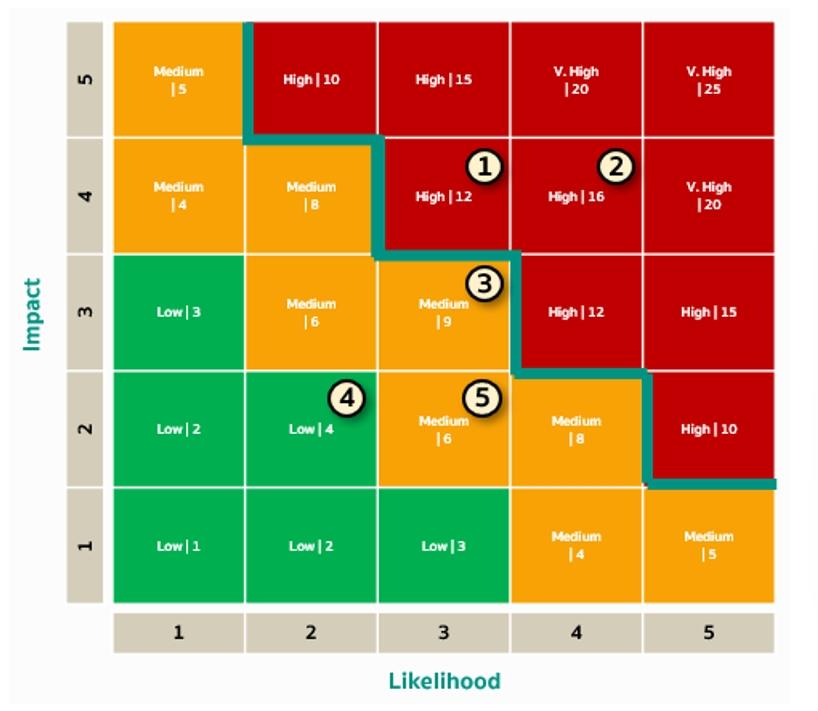
Risk Factors — Overview
Risk Factors — Introduction
The company operates a real estate development business, aiming to create added value for customers, investors, and communities through the development of projects that meet market demands and ensure long-term sustainability. However, real estate business operations continue to face risks associated with external factors, such as global economic volatility and changes in government policies. Consequently, the company has implemented a comprehensive risk management strategy. The significant risk factors that may impact the company's business operations are detailed below:
Risks to the Company's Business Operations
Risk Register
| Risk Name | Risk Characteristics | Consequences | Management Measures | Related Risk Factors |
|---|---|---|---|---|
| Competitive Risks in Real Estate Development Business | The real estate development business in Thailand faces relatively high competition from both major developers listed on the stock exchange and other market players. Competition is evident in various aspects, such as project location, project style and design, pricing, in-project facilities, as well as marketing and sales promotion strategies. Furthermore, some developers may employ pricing strategies, offer discounts, or organize sales promotion activities to stimulate sales during periods of intense market competition, which could lead to an increase in the level of competition within the industry. | Increased competition may compel the company to adjust its pricing and marketing strategies to maintain competitiveness, which may impact the project's profit margins, as well as the company's ability to sell projects during certain periods. If the company fails to develop projects that adequately meet market demands, this could affect the company's operational performance and long-term competitiveness. | The company places importance on continuously studying and analyzing market trends and consumer behavior to utilize such information in project development planning. It also emphasizes the selection of potential locations and the development of projects suitable for target customer groups. Furthermore, the company regularly monitors market competition conditions to enable the adjustment of business strategies to suit changing market conditions. | 1714 · Description: Competition risk · Info category: STRATEGIC_RISK |
| Risks from economic fluctuations affect sales and project ownership transfers. | The operation of real estate development businesses is related to the overall economic conditions of the country, interest rates, household debt levels, and the lending policies of financial institutions. Such factors may affect consumers' purchasing power and their decisions to purchase residential properties. | During an economic slowdown or when financial institutions are stringent in approving loans, consumers may delay their decision to purchase residential properties or be unable to obtain loans for purchasing residential properties. This results in a decrease in project sales and property transfers, which may impact revenue. Cash flow and the company's business operational plan | The company continuously monitors economic conditions and market trends to inform project development planning. It also diversifies project types and locations to cater to a wide range of customer segments. Furthermore, the company manages costs and cash flow appropriately to accommodate economic fluctuations. | 728 · Description: Volatility in the industry in which the company operates · Info category: STRATEGIC_RISK · 1715 · Description: Economic risk · Info category: STRATEGIC_RISK |
| Risks from the transition to an aging society | Thailand is trending towards an aging society, which may lead to changes in consumer housing demand patterns, such as Demand for housing suitable for small families or housing that supports the lifestyle of the elderly | Such changes may lead to a decrease in demand for certain types of residential properties or a shift from the original demand. If the company is unable to adapt its project development models to align with market trends, it may impact the company's competitiveness and long-term business opportunities. | The company continuously monitors demographic trends and consumer behavior to utilize such information for planning future project development and adapting product formats to suit evolving market demands. | 729 · Description: Behavior or needs of customers / consumers · Info category: STRATEGIC_RISK |
| Risk from Climate Change | Climate change and natural disasters, such as floods, storms, or rising temperatures, may impact the development and operation of real estate projects, and may lead to the establishment of stricter environmental standards. | Such risks may result in increased project development and maintenance costs, as well as potential damage to the project's infrastructure in certain areas. Furthermore, changes in environmental regulations may affect future project development processes. | The company prioritizes the design and development of projects with consideration for energy and environmental efficiency, as well as monitoring trends in relevant environmental laws and standards to enable appropriate adaptation and risk management. | 1719 · Description: Climate change and disasters · Info category: STRATEGIC_RISK |
| Risks from the issuance of new regulations, rules, or laws related to the real estate business. | Real estate project development must comply with relevant laws and regulations, such as town planning laws and building control laws, and environmental regulations, which may change according to government policies. | Changes in such laws or regulations may result in increased project costs or complicate the permitting process. and project development delays, which may affect the company's business plans and operational performance. | The company closely monitors changes in laws and government policies, coordinates with relevant agencies, and utilizes legal advisors to ensure that the company's operations comply with applicable laws and regulations. | 730 · Description: Government policy · Info category: STRATEGIC_RISK |